BETWEEN CENSORSHIP AND VISIBILITY
AN INTERVIEW WITH SUNIL GUPTA
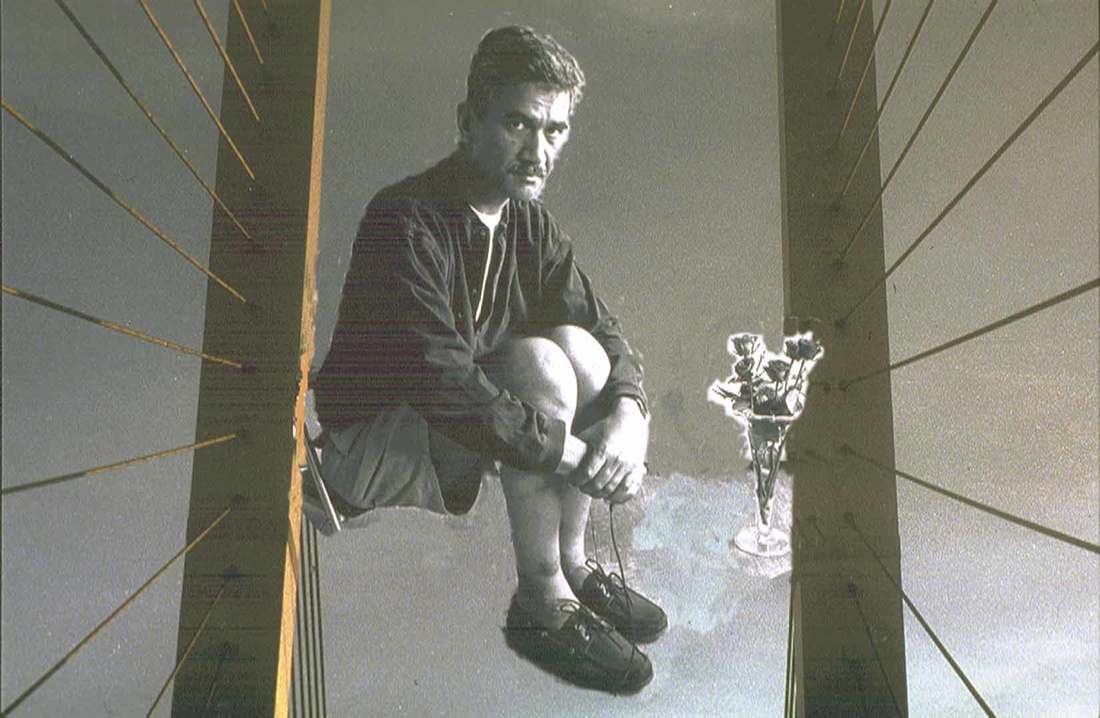
Untitled # 5, from the series Trespass – 3, London/Essex 1995, Archival inkjet print, 30 x 46 inches
Without wanting to impose any rigid classification, photographically speaking, your work moves in the areas of ‘Street Photography’ and/or ‘Documentary Photography’ whereby the latter also includes arranged and set-up shots, especially most recently.
When looking into the trajectory of these projects, we get to know main stations of your life that in time and space are culturally remarkably different. In view of being gay, you lived through and experienced vastly different times and eras between shaming and discrimination to a celebration of diversity – however genuine this may be. You spent your childhood in New Delhi and moved with your parents to Montréal when you were 15 years old in 1969. Later you lived in New York and from there came to London in the late 1970s.
You say yourself in several interviews that your lifelong quest is based on the question of: ‘What does it mean to be a gay Indian man? This is the question that follows me around everywhere I go and is present in all my work’. This overview of your projects at the Photographers’ Gallery gives the work a coherence which brings to the forefront why in art we value such very individual personal quests as a document of an experience that reflects very much on the cultural and societal framework that is not a directly visible part of the work. To counteract invisibility and to document aspects of marginalised life is an immediate comment on the mainstream mindset that produces the marginalisation and supresses its visibility. Thinking about margins brings to attention that the predominant – the ‘normal’ is a framework based on a mindset that is questionable.
Your work was recently the subject of a TalkART* podcasts hosted by Russel Tovey and Robert Diament. At some point, Tovey refers to an image that you eventually used within a montage in your series Trespass 3. Tovey: “… you took an image of yourself at your lowest most fearful moment when you’ve been diagnosed [as HIV positive] and you still had the wherewithal as an artist to document that moment “.
It is worth to point out here that in 1995 it was still an extremely frightening diagnosis, as available treatment was far from being as effective and reliable as it is today. In your answer, you recall that moment of hearing the shock diagnosis and you speak of the cathartic effect of the process of the making of the image a few days later. You speak of the ‘mechanics of the process’ setting up the camera, using a tripod, developing film, ‘going through these steps to make it happen’ and you say that it ‘helps you focus’.
I personally find catharsis an incredibly enlightening concept through which to look at all sorts of human activity. Whilst the term is used in different contexts in different ways and hence there is no all-fitting definition, the word originates from the Greek term katharsis meaning ‘cleansing’ or ‘purification’. Aristotle used the term when looking at the effect of witnessing the resolve of tragedy as a viewer of staged drama. It is also central to Freud’s psychoanalysis, which aims to make patients remember traumatic experiences, which are ‘buried’ or repressed in the subconscious but are causing anxiety and other mental and/or physical illness – which gets released through the process of ‘unearthing’ the memory and remembering the trauma consciously. Medical doctors know, that in some cases a patient’s ailments can be relieved just through the fact that the patient talked about it to the doctor. Art is often understood to be cathartic in nature both for the maker and also in a different way for the audience experiencing the artwork. Of course here it is not always about releasing repressed trauma and catharsis can be a relatively conscious and deliberate act and hence in a way exactly like you describe and use it when you refer to this process of making the work in a moment of extreme anguish.
Whilst the myth of the suffering artist appears largely romanticised and exaggerated, it also seems that it is not entirely baseless. Apart from this specifically traumatic moment of receiving this diagnosis do you see the theme of ‘catharsis’ having a more general presence in your work in view of your overarching quest or was it just this moment?
SUNIL: No it's something that has become second nature. Whenever something dramatic happened, whether it was the HIV diagnosis or being dumped by somebody suddenly or somebody's cheating on you – then I kind of pick up the camera. It's a knee-jerk reaction to make some kind of picture about it and it helps me to work through it. You know, it's either that or I have a lot of drink and cry a lot – something that's less effective and a lot less productive. Some of that might happen but the picture part was what has been quite helpful! Also I find the research that you do for the pictures effective in that way. Like, when I did the ‘Couples’ [shot in 1984 in London and published as Lovers: Ten Years On in 2020 by Stanley/Barker, England] I had to go out and meet a lot of them and that process, the meeting of the couples – I met 30 couples and that was already good. To start with, I only knew a few but they passed me on to some other friends. Suddenly I met a lot and so it helped me to overcome the breakup that I was experiencing in my own life – by being around, hearing them and figuring out for myself that this wasn't, like, the end: It could be like just a break for me and then we start again somewhere. But for a while it felt really like quite like the end. It's hard to explain it was the first time it had happened to me. It was a crucial age period. I was with this person from the age of 20 to 30. I went from being a student to being a normal working person. It never occurred to me that there could be this big breakup. I don't know why, you know, it's just like fiction. It happens to other people not you. Like the coronavirus now.
KLAUS: Yes – and often art is being connected to being cathartic and art is something that you do all your life. So, even in projects that are not that personal is there an aspect of that as well?
SUNIL: Yes, I think so. Although I do photography, my background from the art school means that I’m more into printing which is quite hands-on. The process is very absorbing, you know. It takes you to another world, so for a while you don't think about your problems. It's about getting really involved in the process. I had a bit of a moment between analogue and digital when there was some conflict in my own printing processes, but thankfully that has been resolved.
KLAUS: Not only because this issue of King Kong is devoted to the theme of fetish I found another thing you said during the TalkART podcast remarkable. Still talking about that moment you were diagnosed you also said: ‘With photography and me – I kind of make myself the image and then its not me it’s the image and then things can happen to that – that can have the HIV and that creates a way for me to carry on – the real me … There is a distance. It’s like an avatar – and stuff is happening to that’. This ‘distance’ is of course confirming the cathartic role. But further – here is a case of the photographic image as a fetish in one of its pure forms: an object that is an image with ‘magical powers’: Something that is taking on a life of its own and things can happen to that in place of the real you! Is this an approach to photography that informs your work in general or was that more spur-of-the-moment comment in that podcast.
SUNIL: No I think it became relevant to me especially around that HIV-time – that body of work when I exposed my own body in public. I was nervous about it but I thought it had to be done if I’m going to be talking about it. I didn't actually start out planning to put myself in the picture, I must say, but I needed a South Asian gay guy who was positive and nobody I knew wanted to be in the picture. That's usually my problem: nobody I know wants to be in the picture. So it is more ‘convenient’ to have myself posing, but I didn't think about the consequences until I made the prints. Only then I realized that, especially with the first image where I’m naked and you can see everything. That was a bit strange to put out in public. Until then I thought it's like an extension of me – literally. But when it was on the wall, I realized it's not me. It's something else – and that I can now think about that body and what's happening to it with more distance like from a third-person-objective point of view.
KLAUS: Well, I think of it also that when an artist especially in photography photographs themselves it's not necessarily really about themselves is it? As you say – you couldn't find a model so it's almost a little bit like a universal model that you can find when you do it yourself? But that idea is really at the core of your whole project, isn’t it?
SUNIL: Absolutely!
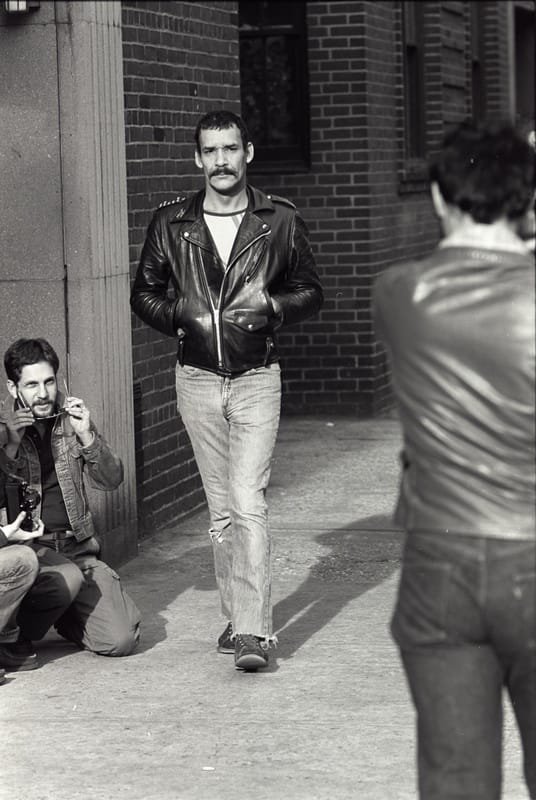
Untitled #1, from the series, Christopher Street, New York 1976
Archival
Inkjet Print 7.5 x 11 inches
SUNIL: No, no I was doing it at the time because, basically, that's how I selected the people in the pictures. There were endless people to choose from. And it was literally like that song about too many men and not enough time and I really thought that by shooting them through the camera and capturing an image, it was almost as good as having sex with them. And I think because the act was like cruising, so I would see somebody and sometimes I could walk up to them and I felt very confident, I guess it’s a way how you catch somebody's eye in the street. I would just walk over to people and take a picture. There were no words exchanged or anything and I didn't have a discussion I didn't say: ‘I’m a student and I’m doing a project’. Everywhere I looked about were all these really good looking guys who were all available. It was the first time that I have seen so many – so available and in public. I was so excited and there was so much of it that I just kept shooting – I never really saw the pictures. It was just in the taking – my excitement was looking through the lens and pressing the shutter and then it's like the ejaculation was over and then I’m not interested in seeing the actual picture. I never saw them at the time. I think I made about three prints then, and it's only now people had an interest and then I printed them. I’ve seen some of them for the first time only now.
KLAUS: You said you did walk up to them but also often it looks as though the people were not even aware of you, or?
SUNIL: Yeah sometimes they're just going by but actually, what I do realize in retrospect and what I didn't think so much at the time is that I did look slightly different because I’m brown. It depends on where I am, but in New York people thought I was Puerto Rican. And most of the people actually were white on that stretch of the street. And so I did look obviously different a little bit because little old ladies would cross the street when they saw me. Some people thought I was going to mug them. But also I was trying to look like them myself. So I was also kind of offering myself in a way. Some people did stop a little bit and catch your eye. There's a guy who's actually leaning against a building, unusually, and he was just hanging out there. So that one I did walk up to and I stood right opposite to him on the pavement and very obviously took a picture but I think people in that time didn't mind so much. I don't know if people would do that now.
KLAUS: There is another issue that is interesting to look at in a different ‘fetish’ context. Also during the TalkART interview you are being asked how it feels that several of your works are in some of the big public collections, places such as the Tate in the UK or MOMA in New York to name only two. You also recall in some other interviews that after you finished at the Royal College of Art you very consciously turned your back on the art market of the time (which the RCA in those days prepared students for, also having very vivid connections to the market). In your answer, you reflect on a memory about your teacher, Lisette Model, with whom you studied Photography for that year in New York and whom you describe as being very influential and enthusiastic. You remember her saying something like: ‘When your work is dead and lost its bite it will end up in a museum.’
What is the case here is a dramatic change in the status of the art object – in your case the prints of the work. What is the result of a cathartic process for you becomes a fetish object for a collector or a national collection. The nature of any object or artefact changes when it becomes part of a collection. It will have lost its initial context and cultural references. In photography studies the interrogation of context is specifically important. This tension between what an artist sets out to do and what the art market makes or does not make of it, is of course a known dilemma for all artists. Some worry about it more than others. Some make it a part of what they do. How do you feel about this change of meaning of your work? This progression to a fetishized art object that you have very little power over once it is out of your hands. Has it/does it influence how you work and how you plan projects?
SUNIL: I’ve had a very pragmatic experience from moving back to India in 2005 and discovering a world where there are no grants, no Arts Council and no government funding. There are some government institutions but everything is so corrupt and everything is very poorly managed. So they almost don't exist and the private sector is supposed to step in and fill the gap. Basically, the art world in India is made up of commercial galleries and in order to survive there I had to fit in to do anything you had to, in order to sell the pictures. That is how I got involved with the Indian art world and luckily for me you could say the timing was great! I didn't realize this at the time but the bigger global art world of Art Basel and all that had finished discovering South Africa and China and they were just about to arrive in India. I was just there when they came and I had this extraordinary experience because I had no background in this art world. And of course you know what London is like, so historically in the art world of the 80s London was not interested in photography anyway, because they only wanted photographs by ‘fine artists’. The Tate wouldn't buy your pictures but you probably could have given them to the V&A for free because they had no budget anyway but once they got your pictures then you became a officially a ‘photographer’ not an ‘artist’ and Tate Modern would never touch you. So it was a kiss of death also. It was a very conflicting time anyway and I didn't get involved with any of that. And suddenly in the 2000s I’m sitting in Delhi and every winter there were big gangs of curators coming from the Met, from MOMA, from Guggenheim, from Tate from Pompidou and suddenly I’m getting opportunities I would never have gotten in London. I got to have an exhibition and I got a residency for a month in Paris to make Sun City and then they've showed it at the Pompidou Centre. It was extraordinary for me, someone like me who was so outside the system. Suddenly, I got to meet London people like Julia Peyton Jones and Hans Ulrich Obrist from the Serpentine. They were there doing these half an hour interviews with the local people – this kind of research – and I said ‘but I live just near you!’ But I think they want to find ‘authentic’ Indians in India. They don’t want to find them in Berlin and in London, they want to find them there. That's also another problem issue of some kind. So I got found there and then suddenly I was in several group shows about India whenever there was an India show, you saw me there. There was one in Paris there was one in Basel there was one in Valencia, there was one in New York. I became one of those people who appears in all of those Indian shows.
KLAUS: That really is extraordinary to hear and says really a lot about the vagarious workings of this art world and its following of homogenised – if not to say fetishized – trends!
SUNIL: The globalised neo-liberal version of contemporary art seems to live in the rarefied and monied world of biennales and art fairs that nowadays occur also in the non-West. It meant that I had the opportunity to meet with Yoko Ono and Rebecca Horn when they visited in Delhi, in a way that isn’t possible to meet them in London. I find although the contemporary artists lists are internationalising they are equally creating bankable canons and reputations so we see more or less the same names everywhere for the past decade. On the other hand, I belonged to a queer activist group that put on a cultural festival every year including an art show that took place on the premises of the local Goethe Institute in Delhi. A safe space for us, as it had diplomatic immunity as it was part of the German embassy and we could not be prosecuted for showing works that might have provoked censorship and legal entanglements in local venues. So the international aspect did have some political advantages.
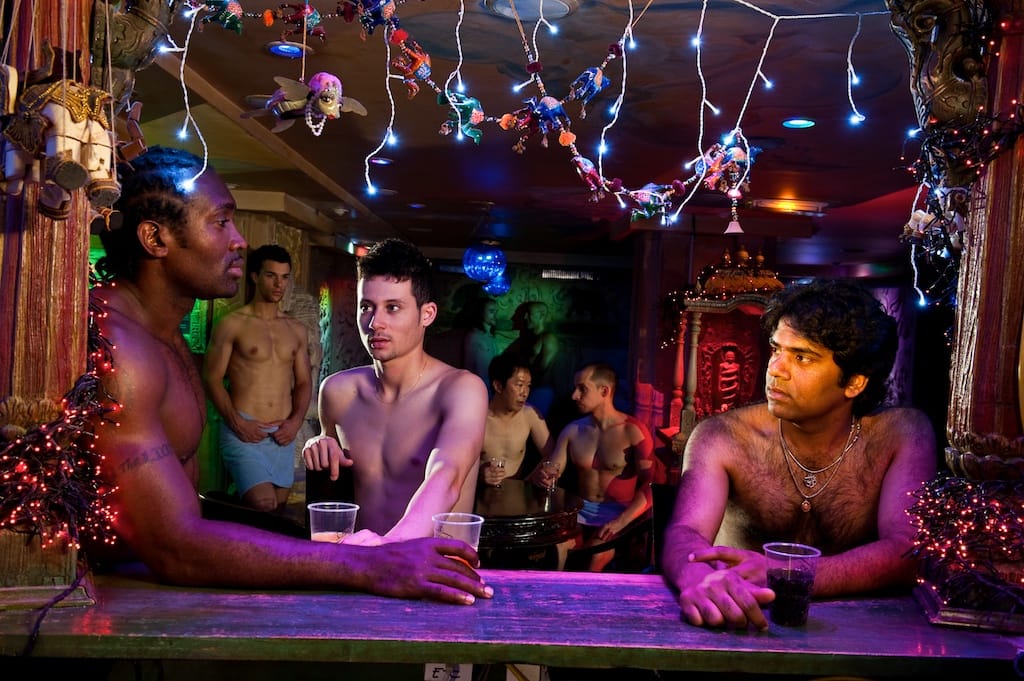
Untitled #9, from the series, Sun City, Paris 2011
Archival Ink
Jet print 100x60 cm
KLAUS: Wow – what happened?
SUNIL: Already, because I made Sun City for India, people in the pictures are just looking and you never actually see any genitals. I have to be careful that it's okay for the Indian market, so I thought I made it quite carefully but I think I made it too well… so they immediately could read the homosexuals’ look, the gaze, the way people looked at each other, so there was some outrage about that: enough to cause the police to act. That was unfortunate. I think it was a coincidence that the wrong kind of but powerful figure - some guy like a retired bureaucrat from the government who had some power, decided not to like it and also decided to go to the local police station who had no choice, I think, but to react to him because Indian cops don't normally come to art shows to have a look, anyway. It was said that it was ‘against Hindu culture’ – this is the big right-wing thing everywhere. It's ‘against Islam’ or it's ‘against Hinduism’ which is nonsense of course and it doesn't work legally. Legally what they do is to make it ‘obscene’. India still has the old English obscenity laws; they have all kinds of terrible old English laws and ‘obscenity’ is one of them. It's very vague you don't have to define it but if the police say it's obscene it's obscene and you are in trouble: you go to court and all that business. Until it is resolved the work becomes ‘illegal’ and they burn it – they literally burn it! It's like the Middle Ages: They get to get rid of it! So, the pictures had to be hidden. It was really crazy, I had to hide them in somebody's house and we were waiting to see if the cops would arrive and all this was nuts. But the few buyers that I had in India are well-to-do slightly closeted gay guys. They don't want any big exposure like that. All the possible selling ended right there! That is what the right wing does in India. They don't have to even win a case, they can close you down just by bad publicity like this, so everything around you won't work anymore. Then I made a decision to come back to London where at least I could find work in teaching.
Then a couple of years ago, suddenly the Hales Gallery said they wanted to represent me! I never know how those things happen – people keep coming to have a look and we never see them again. So this one person came and he actually said, okay I’m going to sell your pictures for you. And now suddenly I’m in this commercial art world and the system of that. I’m trying to fit into it because I’ve been very chaotic historically because I wasn't planning to do this.
KLAUS: Yes - so does this change things? Do you start thinking about what you can do and what can sell? Does having a gallery change how you work?
SUNIL: Yes, everything got bigger. The pictures got bigger and they want me to have fewer pictures but bigger and now my pictures also became expensive. Now my friends can't buy anything so I find that's a bit sad, but I do like the fact that they can make me money much more than the college can. It is quite new to me but I’m feeling it a little bit liberating because I finally – I’m 67 now – and I’m finally feeling financially a little bit secure; enough to now do whatever I want to do.
Klaus: Yes – that's fantastic!
SUNIL: Because up till now I was kind of just trying to survive and so everything depended on some government grant system, so I find selling pictures frees up time. Now I’m excited to having a studio again and I’m trying to think: What do I really want to do with this – what kind of pictures I want to make. It's just that I’m 67 and not 47.
KLAUS: Another issue I wanted to address and now that you told me this story from India even more so: You talk a lot about how you moved from Delhi to Montréal and New York and from there how different London was at the time for you. You've experienced so many really, really different mindsets and ‘visibility’ has always been a big aspect of your work. Your projects cover some truly bleak times regarding gay discrimination and today there is a certain historic aspect to some of these projects, reminding on repressive mindsets that have in some cases partially changed – and often younger generations take for granted what they grew up with.
For example, as you also reminded recently in an Instagram post, only 21 years ago in 2000 the House of Lords voted down an attempt by Tony Blair to repeal the disgraceful ‘section 28’ implemented by the Thatcher government only in 1986! It is fantastic to see that the mainstream entertainment industry is also producing ‘visibility’ now. There are more and more films/series that feature characters who happen to be gay as opposed to making this fact the problem issue of the drama. One very recent series (where it is the main theme), dealing with gay life in the time of AIDS in the UK in the 1980s/early 90s has just come out on BBC, called ‘It’s a Sin’. What is your opinion on this kind of mainstream work? (if you have seen it?...)
SUNIL: Yes, I did watch that – that's my time! Me and many of my friends feel so happy that something like this is now on mainstream television. It's visibility!
KLAUS: How sincere and lasting do you personally think this moment in time will be? I mean for you it must feel like a pocket or do you think this is some sort of progress that will stay?
SUNIL: I’ve become very aware of how our situation is dependent on who our leaders are and we are vulnerable to change. It's not a steady progress from bad to good it can do a U-turn as we saw in Germany in the 30s and as we can see in other countries also. My experience was very weird because I came to London in ‘78 from New York, from Christopher Street, which looked so easy and so available and so public – to a London which was just the opposite. In London people were being persecuted. People were hiding. I saw in the newspaper the other day that the UK has the largest number of actual arrested gay men. I think something like more than sixty-eight thousand! I think even in India where it was illegal maybe they arrested six people in 200 years. If you look at the legal history –because you need a witness – somebody has to see you and report you. Who's going to be bothered anyway? But here the police were actually trying to get you. They legalized sex here in the 60s but they made cruising the same as soliciting sex work. So you probably heard about that there were these pretty policemen hanging around in toilets at Waterloo station and others. And if you spoke to somebody they arrest you, you know that's what was happening! They offered themselves and then arrest you! What I found in London was really an atmosphere of intolerance and fear. I really found it oppressive and quite difficult.
KLAUS: It’s great to see how things have changed since then! Thank you so much for talking to me! I can’t wait to see what work you will make next – is the Hales Gallery planning a show with you?
SUNIL: They are going to do a show this year in London. Because they have two places, one in New York and one in London. Christopher Street has been in New York with Hales and this year they are planning to do one here – the date is not yet fixed... but I can confirm that they will show the New Pre-Raphaelites series.
All projects mentioned in this interview can be viewed on Sunil’s website: www.sunilgupta.net
Sunil’s Instagram: @suilgupta7402
Sunil’s galleries: Hales Gallery, London/New York | www.halesgallery.com
Vadehra Art Gallery, New Delhi | www.vadehraart.com
Stephen Bulger Gallery, Toronto | www.bulgergallery.com
* The talkART podcasts are hosted by Russel Tovey and Robert Diament and are available as Apple Podcast or on Spotify.
Follow talkART announcements and updates on Instagram: @talkart
PS: The print publication of this article featured different images specifically shot by Sunil for King Kong.